NEON
Overview
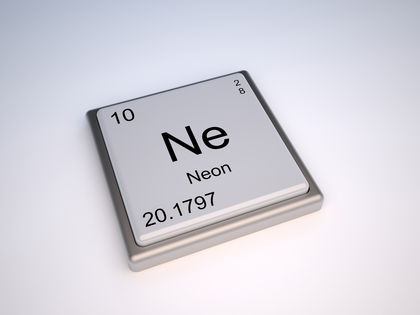
Neon is a member of the noble gas family. Other elements in this family includes helium, argon, krypton, xenon, and radon. These gases are in Group 18 (VIIIA) of the periodic table. The periodic table is a chart that shows how chemical elements are related to each other. The noble gases are sometimes called the inert gases. This name comes from the fact that these elements do not react very readily. In fact, compounds exist for only three noble gases—krypton, radon, and xenon. Chemists have yet to prepare compounds of helium, neon, or argon.
Neon was discovered in 1898 by British chemists William Ramsay (1852-1916) and Morris Travers (1872-1961). It occurs naturally in the atmosphere, but only in very small amounts.
SYMBOL
Ne
ATOMIC NUMBER
10
ATOMIC MASS
20.179
FAMILY
Group 18 (VIIIA)
Noble gas
PRONUNCIATION
NEE-on
Neon has relatively few uses. The most familiar is neon lighting. Today, neon signs of every color, shape, and size exist. Neon signs are often filled with neon gas, but they may also contain other gases as well. The gas contained in the sign tube determines the color of light given off. The color given off by neon itself is reddish-orange.
Discovery and naming
It took humans centuries to understand air. At one time, philosophers thought air was an element. Among the ancient Greeks, for example, the four bask elements were air, fire, water, and earth.
The first research to disprove that idea was done in the 1770s. In that decade, two new elements were discovered in air: nitrogen and oxygen. For some time, chemists were convinced that these two gases were the only ones present in air. That idea is easy to understand. Between them, nitrogen and oxygen make up more than 99 percent of air.
But over time, chemists became more skilled at making measurements. They recognized that something else was in air besides nitrogen and oxygen. That "something else" accounted for the remaining one percent that is not nitrogen or oxygen. In 1894, a third element was discovered in air: argon. Argon makes up about 0.934 percent of air. So, nitrogen, oxygen, and argon together make up about 99.966 percent of air.
But what was responsible for the remaining 0.034 percent of air? Chemists knew that other gases must be present in very small amounts. But what were those gases?
That question was answered between 1895 and 1900. Five more inert gases were discovered in air. One of those was neon.
Detecting gases in very small amounts was very difficult in the 1890s. Equipment was often not good enough to capture a tiny fraction of a milliliter of gas. But a new method, called spectroscopy, was developed that "sees" even small amounts of an element. Spectroscopy is the process of analyzing the light produced when an element is heated. The light pattern, or spectrum, produced is different for every element. The spectrum (plural: spectra) consists of a series of very specific colored lines.
In 1898, Ramsay and Travers were studying the minute amount of gas that remained after oxygen, nitrogen, and argon had been removed from air. They heated the sample of gas and studied the spectrum produced by it. Ramsay and Travers found spectral lines they had never seen before. They described their discovery:
The blaze of crimson light from the tube told its own story, and it was a sight to dwell upon and never to forget. It was worth the struggle of the previous two years; and all the difficulties yet to be overcome before the research was finished. The undiscovered gas had come to light in a manner which was no less than dramatic. For the moment, the actual spectrum of the gas did not matter in the least, for nothing in the world gave a glow such as we had seen.
Ramsay's son was one of the first people to hear about the discovery. He wanted to name the new element novum, meaning "new." His father liked the idea, but suggested using the Greek word for "new," neos. Thus, the element was named neon.
"The blaze of crimson light from the tube told its own story, and it was a sight to dwell upon and never to forget.'
Physical properties
Neon is a colorless, odorless, tasteless gas. It changes from a gas to a liquid at -245.92°C (-410.66°F) and from a liquid to a solid at -248.6°C (-415.5°F). Its density is 0.89994 grams
Chemical properties
Neon is chemically inactive. So far, it has been impossible to make neon react with any other element or compound.
Occurrence in nature and Extraction
The abundance of neon in normal air is 18.2 parts per million (0.0182 percent).
Isotopes
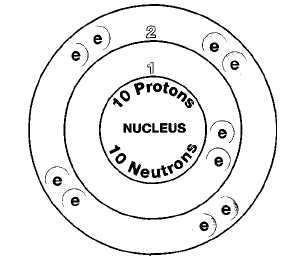
Three isotopes of neon exist, neon-20, neon-21, and neon-22. Isotopes are two or more forms of an element. Isotopes differ from each other according to their mass number. The number written to the right of the element's name is the mass number. The mass number represents the number of protons plus neutrons in the nucleus of an atom of the element. The number of protons determines the element, but the number of neutrons in the atom of any one element can vary. Each variation is an isotope.
Three radioactive isotopes of neon are known also. A radioactive isotope is one that breaks apart and gives off some form
None of the radioactive isotopes of neon has any commercial application.
Extraction
Neon can be obtained from air by fractional distillation. The first step in fractional distillation of air is to change a container of air to a liquid. The liquid air is then allowed to warm up. As the air warms, each element in air changes from a liquid back to a gas at a different temperature. The portion of air that changes back to a gas at -245.92°C is neon.
Uses
The best known use of neon gas is in neon lights. A neon light consists of a glass tube filled with neon or some other inert gas. An electric current is passed through the tube. The electric current causes neon atoms to break apart. After a fraction of a second, the parts recombine. When they recombine, they give off neon light. The light produced is the light given off by the neon light.
Neon lighting was invented by French chemist Georges Claude (1870-1960). Claude displayed his first neon sign at the Paris Exposition of 1910. He sold the first neon advertising sign to a Paris barber two years later.
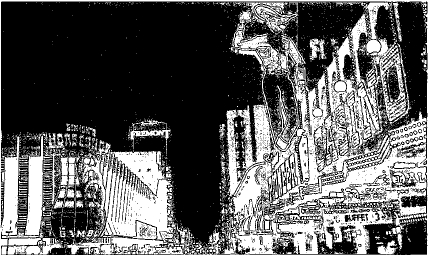
By the 1920s, neon lighting had become popular in many parts of the world. Neon lights were fairly inexpensive, lasted a long time, and were very attractive. Probably the most spectacular collection of neon lighting is in Las Vegas, Nevada. Hotels, night clubs, and restaurants seem to try to outdo everyone else in having the biggest and brightest neon sign.
Neon lighting is now used for many other purposes. For example, neon tubes are used in instruments used to detect electric currents. Neon is also used in the manufacture of lasers. A laser is a device for producing very bright light of a single color. Lasers now have many uses in industry and medicine. They are very efficient at cutting metal and plastic. They can also be used to do very precise kinds of surgery.
Compounds
There are no compounds of neon.
The first neon advertising sign was used by a Paris barber in 1912.
Health effects
There are no known health effects of neon.
Neon is not flammable and has little combustibility. No compounds of neon are found in nature. It is one of the least reactive elements on the entire periodic table along with helium and xenon, also noble gases.
I can't find the answer.
I can't find an answer.